
In the news
Identity is the new target: what Nigeria's 2026 cybersecurity outlook means for you
Deloitte's Nigeria Cybersecurity Outlook 2026 says attackers now go after people's identities rather than systems. What that means as Nigeria goes digital, what's being done, and four habits that protect you.
The Verath team · · 3 min read
Nigeria's digital economy is having a remarkable run. More of our banking, payments, tax and government services now happen on a phone. That growth is good news, and it is also why the people behind fraud are changing how they work.
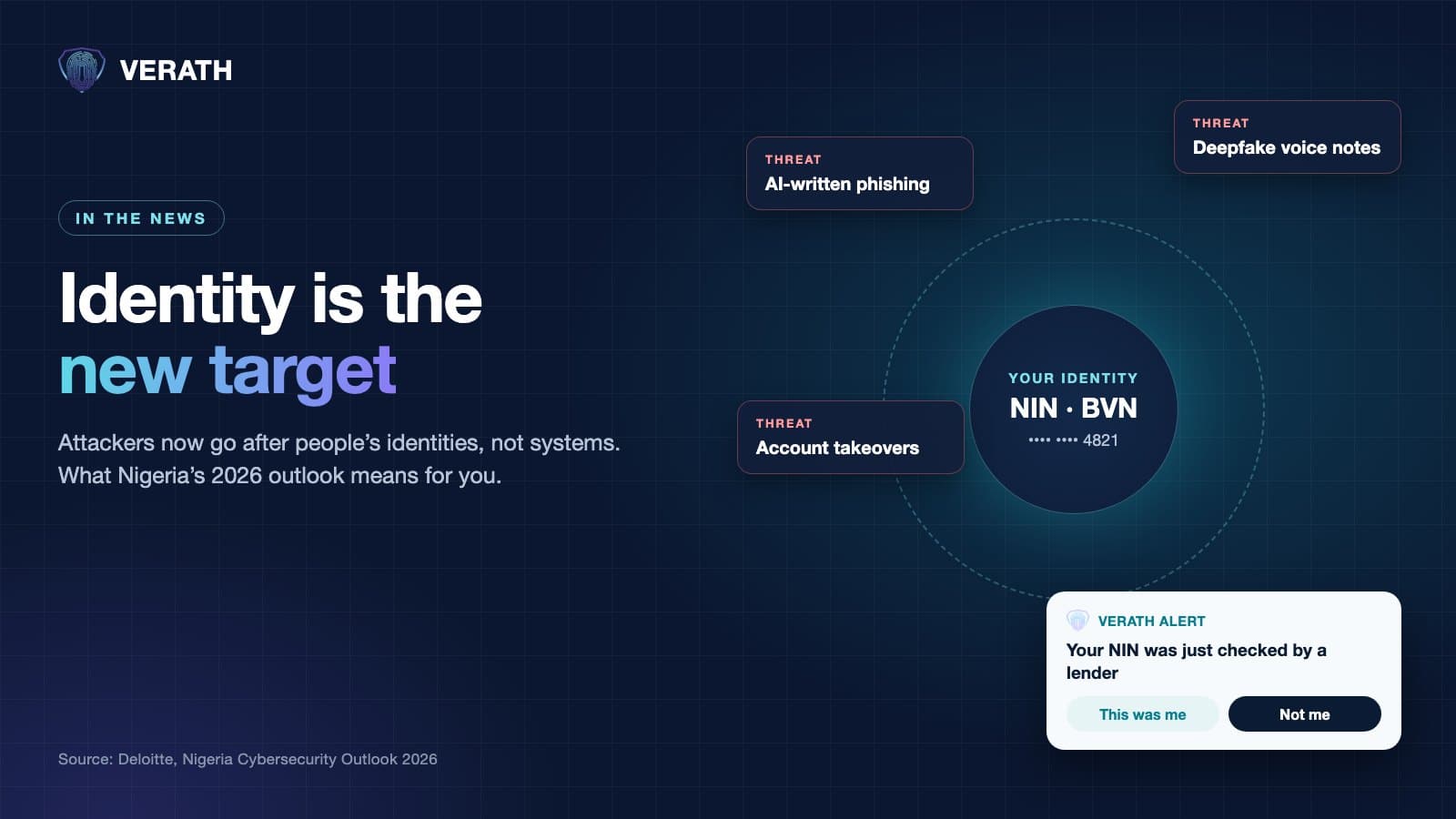
Deloitte's Nigeria Cybersecurity Outlook 2026 puts it plainly: as Nigeria's digital economy grew in 2025, cybercrime grew alongside it, and identity theft and fraud rose sharply, driven by social engineering and account takeovers. Its central warning for 2026 is that attackers are increasingly going after people's identities and access rather than technical flaws in systems.
In other words, it is often easier to become you than to break into a bank.
What the report expects in 2026
Deloitte's outlook highlights a few trends that matter to everyday Nigerians, not just security teams:
- More convincing phishing. AI makes fake emails, text messages and even voice notes sound like your bank, your colleague or a regulator.
- Deepfakes and AI-driven fraud. Realistic fake voices and videos make old warning signs, such as poor spelling, less reliable.
- Identity at the centre. The report expects banks and businesses to move towards "zero trust": checking who is really behind every login and request, every time.
- More services moving online. New requirements such as e-invoicing and real-time transaction reporting will push more businesses, and their customers, further into digital channels.
Enforcement is catching up
Nigeria is responding. The Nigeria Police Force National Cybercrime Centre (NPF-NCCC) has traced more than ₦3.6 billion in suspected criminal proceeds converted into cryptocurrency, in a case that began with a WhatsApp investment scheme. The allegations are still to be tested in court, but the case shows how quickly money linked to online fraud can move.
Anyone can now report cybercrime through the NPF-NCCC e-reporting portal, and government agencies, banks and fintechs are running awareness campaigns this season.
The gap that remains: you
Banks and institutions are investing in stronger checks. But when your NIN or BVN is used to open an account, take a loan or swap a SIM, the institution knows about it, and you usually don't. If identity is now the main target, the person who owns that identity needs to be told when it is used.
That is the gap Verath exists to close. When a connected institution checks your NIN or BVN, Verath alerts you, and you can answer "This was me" or "Not me" while there is still time to stop a fraudulent account or loan. We wrote more about this in Your NIN and BVN are more than numbers.
Four habits for 2026
- Treat urgency as a warning sign. A message or voice note that pressures you to act now, even one that sounds exactly like someone you know, is the most common sign of social engineering. Hang up and call back on a number you already have.
- Never share one-time codes, PINs or your BVN with anyone who contacts you. No real bank, NIMC officer or lender will ask for your OTP.
- Turn on alerts and read them. Bank transaction alerts and app sign-in notifications are your early warning. Unexpected messages about new accounts, loans or "verification" deserve a call to your bank.
- Report quickly. If something is wrong, tell your bank first, then report it on the NPF-NCCC portal. Keep a record of what you reported and when.
Nigeria going digital is an opportunity worth protecting. Strong systems matter, and so does keeping the owner of each identity in the loop.
Sources: Deloitte, Nigeria Cybersecurity Outlook 2026; Business Post, Police uncover ₦3.6bn suspected criminal proceeds converted to cryptocurrency.
Was this article helpful?
Follow Verath on LinkedIn · Questions? Email info@verath.io
Know every time your identity is used.
Verath is in an invite-only pilot. Join the waitlist for early access, or talk to us about connecting your institution.