
Identity safety
Your NIN and BVN are more than numbers
Your NIN and BVN open bank accounts, loans and SIM lines, yet you're rarely told when they're used. Why that visibility gap matters, what you can do today, and how Verath is closing it.
From the Founder's desk · · 4 min read
Your National Identification Number (NIN) and Bank Verification Number (BVN) have quietly become the keys to everyday life in Nigeria. They open bank accounts, unlock loans, register SIM cards and support passport and other government applications. Every time you start one of these, an institution checks your number to confirm you are who you say you are.
That is how it should work. Verification makes services faster and harder to abuse. But it raises a simple question most of us can't answer:
When was your NIN or BVN last checked, by whom, and why?
You are rarely told
Identity checks happen behind the scenes. A lender, bank or fintech asks a verification service to confirm your details, gets an answer in seconds, and moves on. You see the outcome of your own applications. You don't see the checks you didn't start.
Most checks are legitimate. The problem is what happens when one isn't.
When someone else uses your identity
Identity fraud in Nigeria rarely starts with a dramatic hack. More often it looks like this:
- A loan you never took. Someone uses your details with a digital lender. The first you hear of it is a repayment demand, sometimes months later.
- An account you didn't open. Your identity is used to open an account that then moves stolen money, and investigators come looking for you.
- A SIM swap. A fraudster gets a replacement SIM for your number, intercepts your one-time codes, and empties your accounts.
In each case the warning sign existed: an institution checked your identity at a moment you weren't expecting it. You just weren't in the loop.
The gap: verification without the owner
The systems behind NIN and BVN were built to answer one question for institutions: whose number is this? They were not built to tell the person who owns that number that a check took place.
Closing that gap doesn't mean exposing more of your data. It means telling you, the owner, that a check happened, and giving you a way to say "that wasn't me" while it still matters.
What you can do today
You don't need to wait for new technology to lower your risk:
- Never share your BVN, NIN slip or one-time codes with anyone who contacts you, including people claiming to be from your bank, NIMC or a loan company. Real institutions won't ask for your OTP.
- Turn on transaction alerts for every bank account and read them, especially unexpected messages about new accounts, loans or "verification".
- Know which SIM lines are linked to your NIN. Ask your mobile network which lines are registered under your NIN, and report any you don't recognise.
- Protect your phone number. It receives your codes. If your SIM suddenly stops working without explanation, contact your network and your bank immediately.
- Act fast on anything unfamiliar. If you see a loan, account or repayment demand you don't recognise, report it to the institution and your bank straight away, and keep a record of what you reported and when.
How Verath closes the gap
We're building Verath so that you hear about checks on your identity when they happen, not months later.
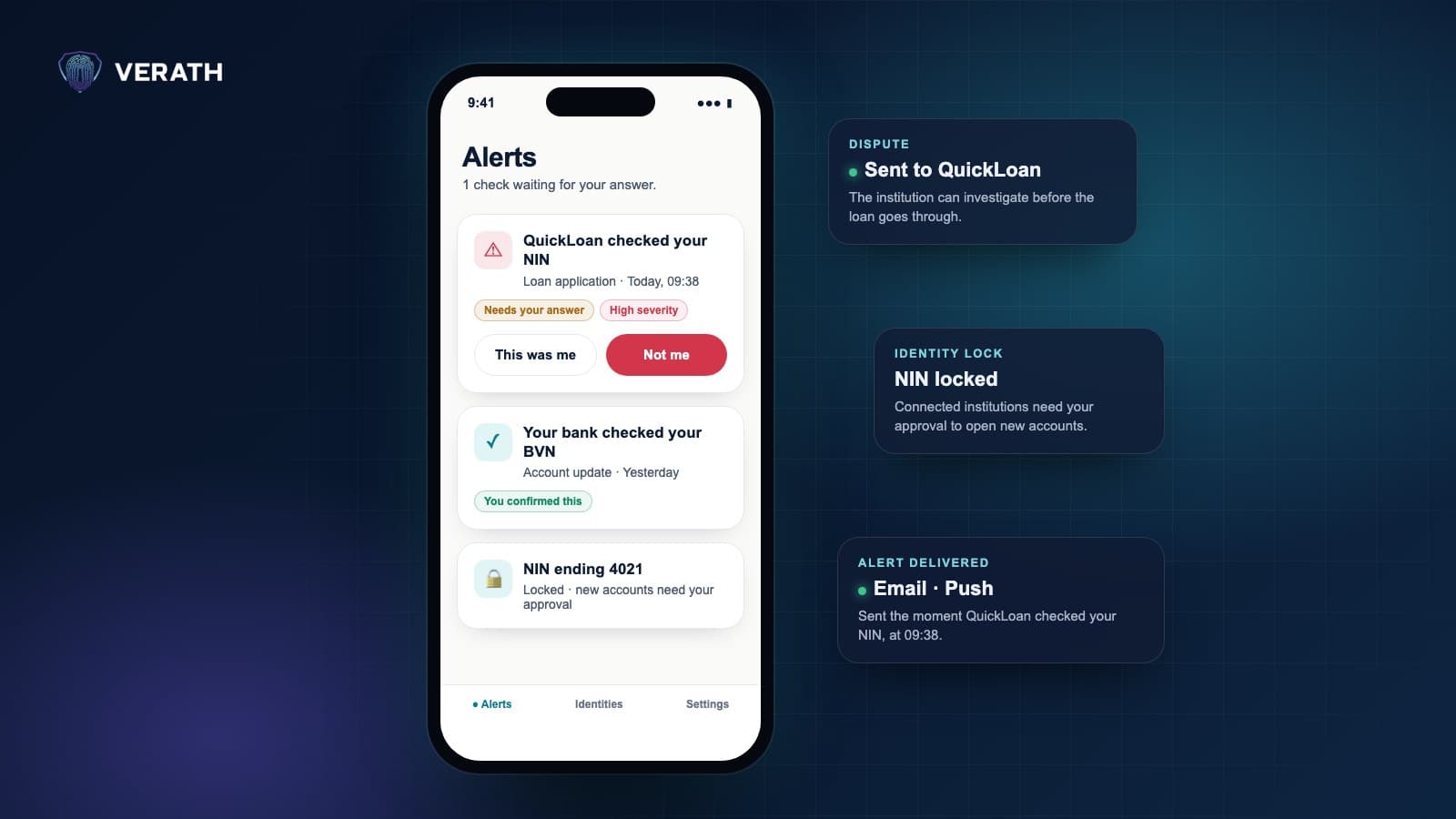
- An alert when your identity is checked. When a bank, lender or fintech connected to Verath checks your NIN or BVN, you get an alert showing who checked it, why and when.
- "This was me" or "Not me". If you don't recognise the check, one tap opens a dispute with that institution so they can investigate and, when it is caught in time, stop the account or loan going through. You can follow the dispute in the app.
- A lock for your identity. If you aren't applying for anything, you can lock your identity. Connected institutions that check locks will then need your approval before opening a new account in your name.
We built Verath to be private by design. We never store your number in plain form: it is encrypted, and institutions only ever see a scrambled version they can't link across companies. Institutions see your response, never who you are.
To be clear about where we are: Verath is in an invite-only pilot. Alerts come from institutions connected to Verath, so coverage grows as more banks, lenders and fintechs join. Today it complements, not replaces, the steps above.
The conversation starts here
Protecting digital identity is a shared job. You protect your details, institutions verify responsibly, and the people who own an identity finally get a say in how it's used. That last part has been missing, and it's what Verath is here to add.
In our next article we'll explain what actually happens when your NIN or BVN is verified: who is involved, what they see, and what you're entitled to know.
Was this article helpful?
Follow Verath on LinkedIn · Questions? Email info@verath.io
Know every time your identity is used.
Verath is in an invite-only pilot. Join the waitlist for early access, or talk to us about connecting your institution.